In today's age, artificial intelligence (AI) is utilized in a plethora of ways. Whether for education, the workplace, or even personal ventures, a large number of people have begun using AI tools such as ChatGPT, Copy.Ai, and other software to help them in their day-to-day life. Nonetheless, as time has moved on, AI has been seen in a more negative light due to actions such as deepfakes, its use in Hollywood, and its abuse by students. As a result, using AI has become synonymous with have a low sense of morality and inauthenticity. However, in more recent times, AI has been transformed into a business tool that has optimized, enhanced, and helped developed small businesses into successful brands without compromising their character ethically and morally.

Does AI Help All Small Businesses?
In the spirit of being both informative and realistic, while AI helps most small businesses, there is one industry that AI is completely unacceptable in and will most likely not tolerate its use in the foreseeable future. If you haven't already guessed, the industry that being alluded to is the art industry. Compared to people who worked in medicine or real estate technology, artists are less positive toward using AI in their field (Latikka et al, 9). The reason for this is because human-made art is more valued and respected than art made by AI. However, outside of the art industry, if you work in a technological occupation, AI is more accepted. Studies have found that "extroverts, older individuals, and women reported less positive attitudes toward AI, whereas those with greater computer experience and higher use of computers reported more positive attitudes toward AI" (Latikka et al, 9). Therefore, if you are an artist, please understand that utilizing AI whether publicly or privately will come with negative feedback.
How Does AI Help?
There are a number of ways that AI helps small businesses that will be discussed later in this blog. Nonetheless, the most important way in which AI builds small businesses into successful brands is marketing and its orientation. Marketing orientation (MO) refers to a business approach that focuses on identifying and finding ways to meet the needs of a company's target audience (CFI, 2023). Researchers have determined that AI is the most effective tool for boosting MO, followed by big data analytics, and then social media marketing research (Zhang and Song, 66). Across four different industries, empirical evidence shows that firms that utilize big data analytics, AI, and social media marketing research tools develop high levels of MO and benefit from it because firms can boost their MO through increasing their AI usage. Consequently, AI serves a big role in helping the MO of any business that needs help understanding the needs of their consumers.
The following image from HubSpot will help understanding the uses of marketing orientation and how it differs from sales orientation.
![What is Sales Orientation? [Definition + Examples]](https://www.hubspot.com/hs-fs/hubfs/sales-orientation_3.webp?width=650&height=433&name=sales-orientation_3.webp)
What Tool Should I Use?
There are several AI tools that we will discuss and learn about. The first tool that we will learn more about is Mailchimp. For those who aren't familiar with the service, Mailchimp is an email and marketing automations platform for growing businesses. It was founded in Atlanta, GA in 2001 by Ben Chestnut, Mark Armstrong, and at a later time, Dan Kurzius (despite the Mailchimp website stating that Chestnut and Kurzius co-founded the company). Mailchimp's mission is to "empower millions of customers around the world to start and grow their businesses with world-class marketing technology, award-winning customer support, and inspiring content" (Mailchimp).
How Does Mailchimp Help?
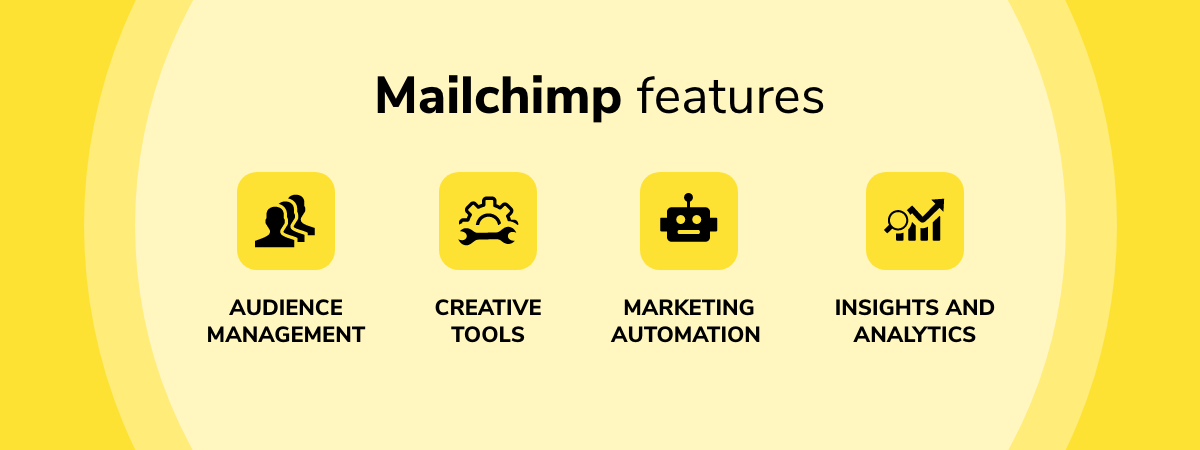
Some readers might still be wondering what Mailchimp actually does and how its supports small and developing business owners. To begin, Mailchimp offers AI-powered services for email marketing, such as grouping consumers into categories and predicting trends. However, there are multiple services that Mailchimp provides that could help virtually any business successfully market and develop their brand through the power of AI. Three invaluable services that Mailchimp offers that helps small business are AI marketing tools, reporting and analytics tools, and audience management tools. For anyone who is considering using Mailchimp, we will examine the three aforementioned services to understand exactly what benefits these tools provide.
AI Marketing Tools
Two of many AI marketing services that Mailchimp provides are its Customer Journey Builder (CJB) and integrations. Mailchimp's CJB automates your campaign for you. The way it works is that after a customer buys a product, they will automatically be signed up for a newsletter. After that point, they will receive an email that promote a recent or upcoming campaign. According to Mailchimp, customers have seen an 127% increase in click rates compared to bulk emails sent by people (Mailchimp). On the other hand, regarding integrations, you can boost the effectiveness of your Mailchimp experience by connecting "store, accounting tools, social media, and more" (Mailchimp). Some examples of what applications or services you can add are but are not limited to Wix, Squarespace, Stripe, LinkedIn, and Shopify.
Reporting and Analytics Tools
Moving on from the AI marketing tools, two reporting and analytics tools that Mailchimp offers are A/B testing and its Content Optimizer. With its A/B testing service, you can learn more about your consumers by sending test emails to specific audience segments and try different "subject lines, images, layouts, and send times to see what’s working best" (Mailchimp). Additionally, you can determine what type of email works best for your campaign and adjust your campaign to attain business goals at a faster rate. Regarding the content optimizer, you can review data to improve your marketing strategies. According to the Mailchimp website, the Content Optimizer "analyzes millions of data points from top-performing campaigns and makes personalized suggestions to improve copy, imagery, and layout in future emails" (Mailchimp). In other words, by studying successful campaigns, Mailchimp is able to provide data that anyone could use to help produce a successful campaign.
Audience Management Tools
Last but not least, two of Mailchimp's audience management tools that can successfully assist small businesses are its behavioral targeting and marketing CRM tools. With the behavioral targeting tool, you can send targeted messages to your customers in response to certain actions. For example, you can "send a welcome message to introduce new signups and customers to your brand, or a related product recommendation for a recent buyer" (Mailchimp). Also, you can view customer profiles to see in which ways a customers has interacted with your marketing campaigns, website, app, or Mailchimp website and send personalized messages based on how they engaged. Regarding the marketing CRM tool, you can build a better connection with your customers. The way this works is that you are provided access to all of your customers' data, you can organize that data into tags and segments, learn the patterns of said customer data, and finally, create automated messages based on the tags or segments.
What's Next?
Throughout this article, we have identified that AI is not just a negative entity. Now there is an understanding that AI (while not suitable in the art industry) helps small businesses develop their brand through the use of marketing and customer related tools. Additionally, we now know the existence of an AI utilized service that have been helping small businesses for over two decades. In the next blog post, we shortly move away from the types of AI tools that help businesses and simply look into the benefits that AI can provide to a business. Thank you very much for reading and please read the next blog post to learn how AI can help your business!
CFI Team. (2023). Market Orientation. Corporate Finance Institute.
https://corporatefinanceinstitute.com/resources/management/market-orientation/
Latikka, R., Bergdahl, J., Savela, N., & Oksanen, A. (n.d.). AI as an Artist? A Two-Wave Survey Study on
Attitudes Toward Using Artificial Intelligence in Art. Poetics, 101.
https://doi.org/10.1016/j.poetic.2023.101839
MailChimp. (2023). Get To Know Our Senior Leadership Team At Mailchimp. Mailchimp. https://mailchimp.com/about/founders/
MailChimp. (2023). Mailchimp Origin, Culture and Corporate Citizenship. Mailchimp.
https://mailchimp.com/about/
MailChimp. (2023). The All-in-one Marketing Platform Built for Small Businesses. Mailchimp. https://mailchimp.com/features/
O’Brien, K. (2019, August 6). Mailchimp co-founder on how he nearly killed off the monkey and
introducing original content. The Drum. https://www.thedrum.com/news/2019/08/06/mailchimp-co- founder-how-he-nearly-killed-the-monkey-and-introducing-original
Riserbato, R. (2020). What is Sales Orientation? [Definition + Examples]. Blog.hubspot.com.
https://blog.hubspot.com/sales/sales-orientation
Zhang, H., & Song, M. (2022). How Big Data Analytics, AI, and Social Media Marketing Research Boost
Market Orientation: Companies can use big data analytics, artificial intelligence (AI), and social media marketing research to increase market orientation. Research Technology Management, 65(2), 64–70. https://doi.org/10.1080/08956308.2022.2022907

Comments
Post a Comment